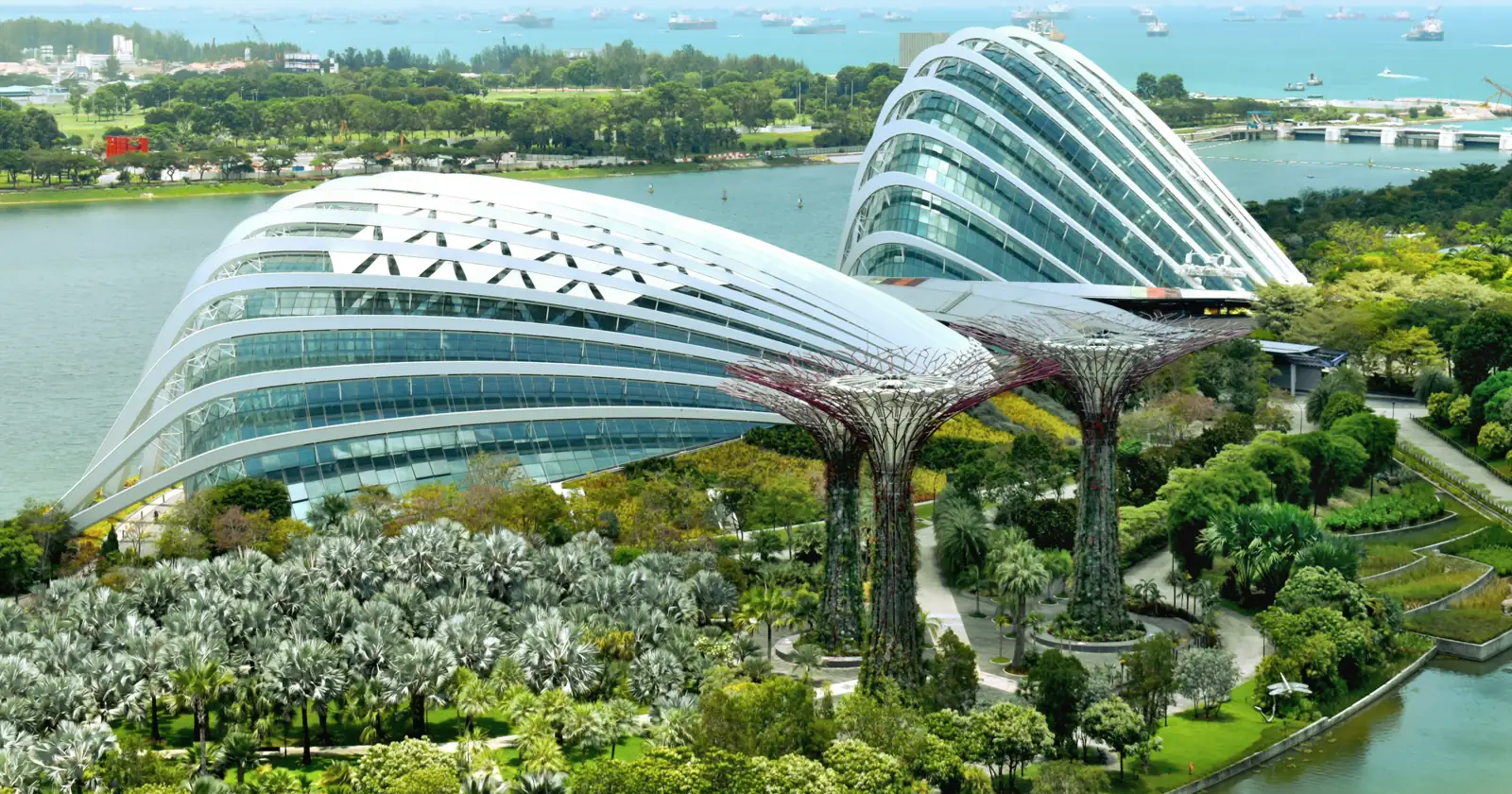
How paving that cleans the air works, what on-site measurements show, and why sunny Singapore is an ideal place for it.
Urban environment By Smartcity Projects · Singapore · 8 October 2026 · 5 min read
Every city is covered in pavement: pavements, plazas, school playgrounds, park paths. Millions of square metres that sit in the sun all day doing nothing but being walked on. What if that ground could also help clean the air?
That is the idea behind photocatalytic pavement, also known as air-purifying pavement. In this article we explain how it works, what the measurements say and where it makes the most sense in a city like Singapore.
The problem: nitrogen oxides at street level
Nitrogen oxides (NOx) are gases produced by combustion: road traffic, industry and power generation. Nitrogen dioxide (NO2) irritates the airways, and NOx also helps form ground-level ozone.
Singapore’s air quality target for NO2 is an annual mean of 40 µg/m³. The World Health Organization’s 2021 guideline is stricter: 10 µg/m³. And concentrations are highest exactly where people are: at street level, next to traffic.
How photocatalytic pavement works
Photocatalytic paving slabs and blocks contain titanium dioxide (TiO2) in their top layer. Titanium dioxide is a common, safe mineral, used in white paint, sunscreen and toothpaste. On a pavement, it acts as a catalyst:
- Light activates the surface. Ultraviolet light from the sun switches on the titanium dioxide.
- Polluted air touches the pavement. NOx molecules in contact with the surface react.
- Pollutants are converted. NOx is oxidised into small amounts of harmless nitrates.
- Rain washes the surface. The nitrates are rinsed away and the surface is ready again.
Because it is a catalyst, the titanium dioxide is not used up. The same reaction also breaks down organic dirt, so the surface tends to stay cleaner for longer.
What the evidence says
In the laboratory, results are clear and repeatable. The international standard ISO 22197-1 measures how much NOx a material removes under controlled light, humidity and air flow. In Spain, the standard UNE 127197-1 goes a step further and classifies photocatalytic materials by their performance.
In the street, what really counts is measuring on site. ecoGranic®, one of the products we work with, has carried out hundreds of on-site measurements since its first test in Sestao (Spain) in 2009, with an average NOx reduction of around 60%. Measurements repeated after more than five years of use show that the effect is maintained.
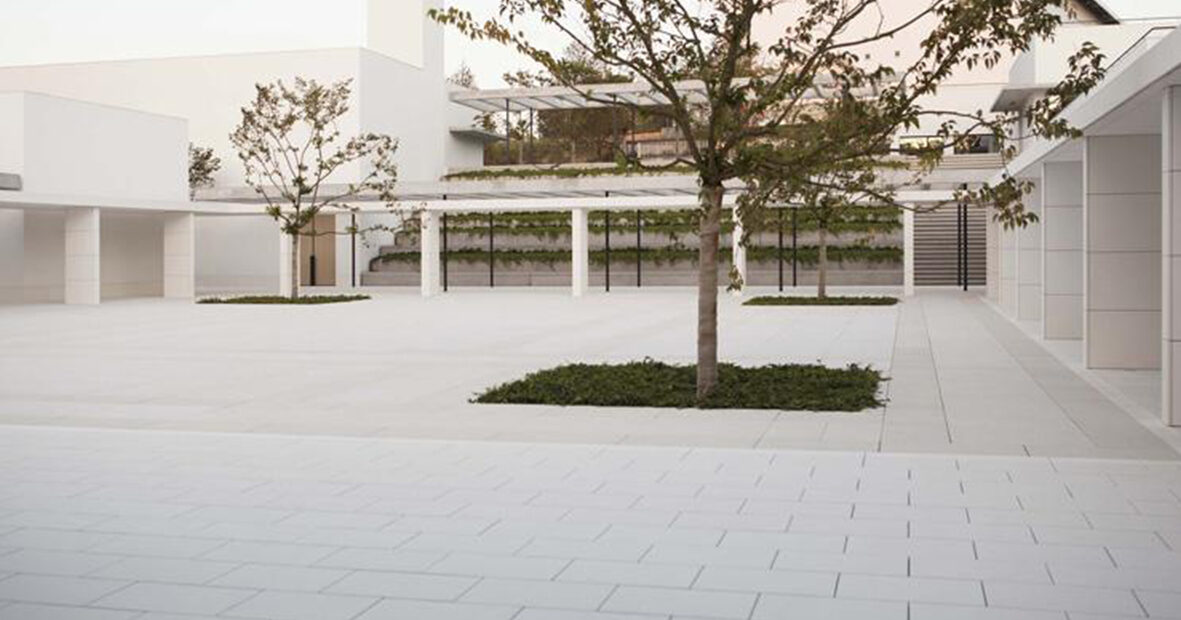
In A Coruña (Spain), the Padre Rubinos building, promoted by the Amancio Ortega Foundation, uses light-coloured ecoGranic® in its courtyards, access areas and walls.
The pavement cleans the air where it matters most: the layer closest to the ground, where children play and people walk. And it works even better as part of a wider plan for cleaner air.
What makes it work better
| Factor | Why it matters |
|---|---|
| Light | More sunlight means more activity. Light colours perform better than dark ones. |
| Contact with the air | Large surfaces in sheltered, calm spots (pedestrian streets, plazas, courtyards) give polluted air more time on the surface. |
| A thick active layer | Thin surface coatings can wear away. A photocatalytic layer several millimetres thick keeps working as the surface wears. |
| A clean surface | Dirt blocks the light. Rain and normal cleaning keep the surface active. |
Why Singapore is a good fit
- Strong sunlight all year. Close to the equator, Singapore has no winter dip in daylight or UV.
- Frequent tropical rain that rinses the surface naturally.
- A dense, walkable city with plazas, park connectors and busy pedestrian areas next to roads.
- A clear direction towards greener materials under the Singapore Green Plan 2030. You can read more in What is a smart city?
Where it makes the most sense
- Pedestrian streets and plazas next to traffic
- School playgrounds and drop-off points
- Parks, park connectors and outdoor sports areas
- Open bus interchanges and car park entrances
- Building forecourts, terraces and light façades
Five questions to ask any supplier
- Which standard was it tested to (ISO 22197-1, UNE 127197-1), and by which laboratory?
- Is the photocatalyst in a thick active layer or only a surface coating? How long does it last?
- Are there measurements from finished projects, and can they be repeated on yours?
- How do colour and finish affect performance?
- Does it meet the usual requirements for strength and slip resistance?
In short
Pavement has to be laid and replaced anyway. When that time comes, choosing a surface that also does something for the air people breathe is a small, low-maintenance step towards a healthier city.